|
AUGUST 2026 |
Strong Legs = Long LifeFour Lower-Body Exercises, No Equipment, Twice a Week 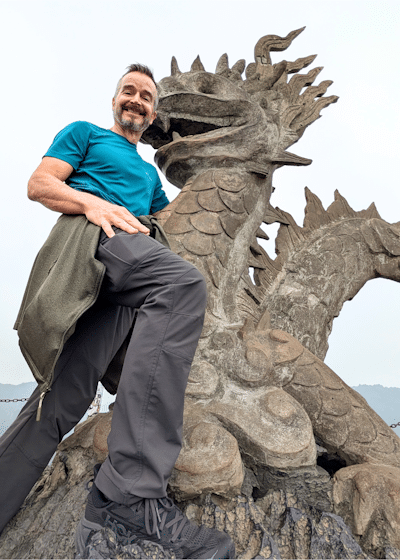
In January, I climbed the 500 stone steps up Lying Dragon Mountain in Vietnam. They’re steep, uneven, worn smooth in places, and the climb is compared to a 20-storey building. But the reward at the top is a stunning view of the jagged mountains and emerald valleys of Ninh Binh. Plenty of people didn’t make it. Some who turned back were younger than me. I got to the top and back down at age 64 (I’m 65 now). That staircase didn’t sort people by age. It sorted them by leg strength. Researchers have a simple test that sorts people the same way. You just sit down on the floor and stand back up, and they count how much support you need on the way. A 2025 study found that older adults who could sit down and rise from the floor without any support at all were far less likely to die over the next twelve years. Those who needed the most help had nearly four times the risk of death from natural causes, and six times the risk from heart disease. The good news is that leg strength is trainable at any age. That’s what the rest of this issue is about. You’ll find four simple exercises you can do easily at home to keep your legs strong for a long, active life. Joe Burjoski (Age 65) |
#1 – the Squat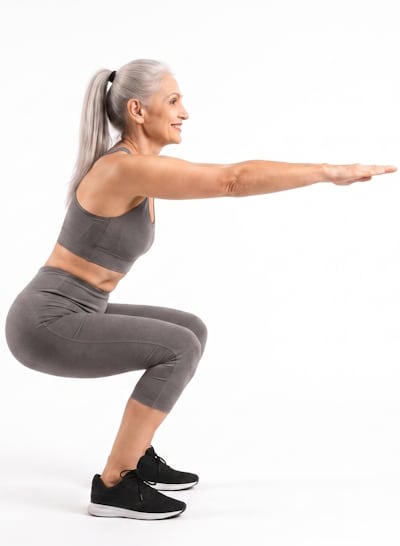
Every time you get out of a chair, you’re doing a squat. Off the toilet, out of the car, up from the floor with a grandchild – they’re all squats. It’s the movement that decides whether you stay independent. The squat trains your quads, hamstrings, glutes and calves together, with your core and back holding you steady. Form: Set your feet shoulder-width apart, toes turned slightly out. Brace your stomach. Push your hips back like you’re sitting into a chair, chest up, weight in your heels. Lower as far as you comfortably can. Push through your heels to stand, squeezing your glutes at the top. Keep your knees tracking over your toes, not caving inward. Heels stay flat. Start with 2 sets of 8 and build toward 3 sets of 12. Five levels of progression:
More important than squat depth is pace: Lower under control, then drive up fast. Speed fades faster than strength as we age, and the explosive drive up helps to preserve it. 📺 Watch this: The #1 Exercise for Seniors to Master for Lifelong Strength |
#2 – the Step Up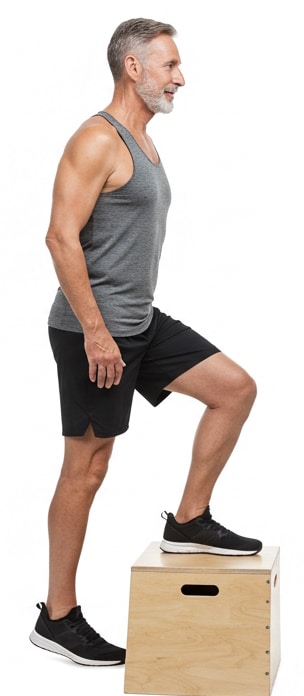
Every time you climb a stair, you’re doing a step-up. Up a curb, onto a bus, over the edge of the bathtub – they’re all step-ups. It’s the movement that decides whether you take the stairs or look for the elevator. The step-up trains your quads, glutes, hamstrings and calves, with the smaller muscles on the side of your hip working to keep you from tipping. Form: Face a step. Put one whole foot on it, not just the toes. Drive through that heel to bring yourself up. Step down slowly and under control. Then switch legs. The way down is the part that counts. Controlling a descent is the same quality that catches you when you trip. Start with 2 sets of 8 per leg and build toward 3 sets of 12 per leg. Five levels of progression:
Your bottom stair works fine. If you want to set the height precisely, I use a plyometric box with 16, 18 and 20-inch settings – I started with bodyweight step-ups, added dumbbells, and eventually worked up to box jumps (see a video demo at the link below). 📺 Watch this: Plyo-box Step Up and Jump Demo |
Free Guide: The Protein Playbook
Exercise signals your body to grow muscle, but you have to provide the building blocks – protein. The Ripped Seniors Protein Playbook shows you exactly how to eat enough protein at every meal to support your lower body strength. Inside you’ll find:
|
#3 – the Calf Raise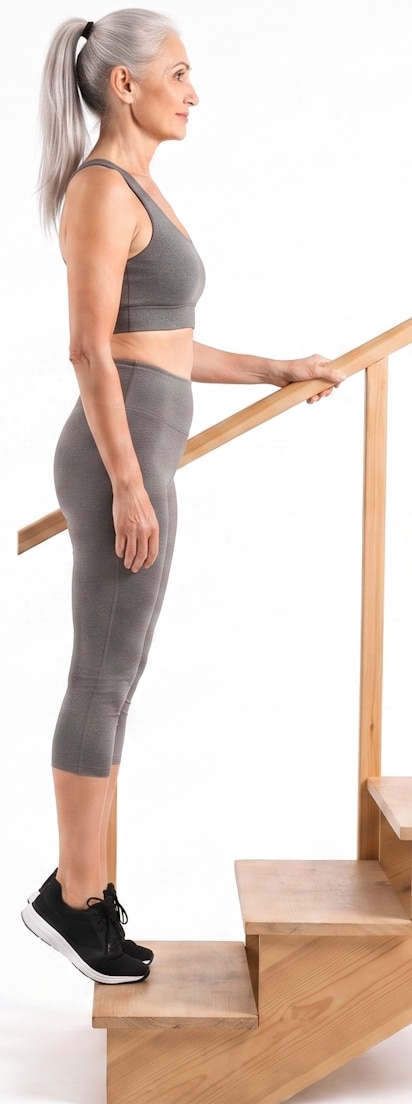
Your calves supply roughly two-thirds of the push you generate with every step you take. Researchers point to fading push-off power as the clearest physical marker of an aging walk. It’s what turns a stride into the slower shuffle everyone recognizes. The calf raise trains the muscles down the back of your lower leg and the Achilles tendon they join up with, plus the small muscles around your ankle that steady the joint. Form: Start with both feet flat on the floor. Once you’re steady, move to the edge of a step, heels hanging off, one hand on the railing. Let your heels drop below the level of the step, then press up as high as you can go. The drop range is important. Do 2 to 3 sets of 15 to 25 reps. Five levels of progression:
Two variations: a straight knee trains the calf muscle you can see. A bent knee trains the deeper one underneath – the one that handles standing and walking all day. Do both. Deep dive here: https://www.nature.com/articles/s41598-023-50275-1
|
#4 – the Glute Bridge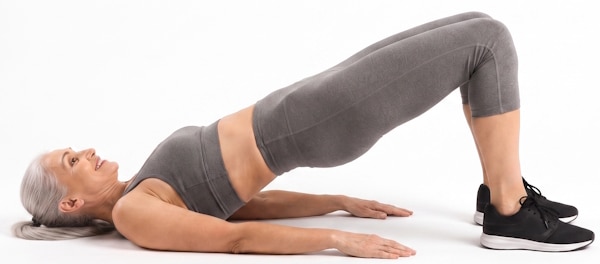
Now get down on the floor using a mat or carpet. The three exercises above are all pushing movements, driven mostly by the front of your legs. The glute bridge trains the other half – glutes and hamstrings, the muscles down the back of you that weaken from sitting and make your low back ache. Form: Lie on your back, knees bent, feet flat and hip-width apart, arms at your sides. Brace your stomach. Press through your heels and lift your hips until your body makes a straight line from shoulders to knees. Squeeze at the top. Lower your hips slowly. Do 3 sets of 12 to 15, resting about 30 seconds between sets. Five levels of progression:
Most people outgrow the two-legged bridge quickly and then keep doing it for years. Get to the single-leg version as soon as you can. It roughly doubles the load with no equipment at all, and it will tell you immediately which side is weaker. 📺 Watch this: Fix Flat Butt Syndrome! 3 Best Glute Exercises for Seniors |
What’S Your Number – Sit to Stand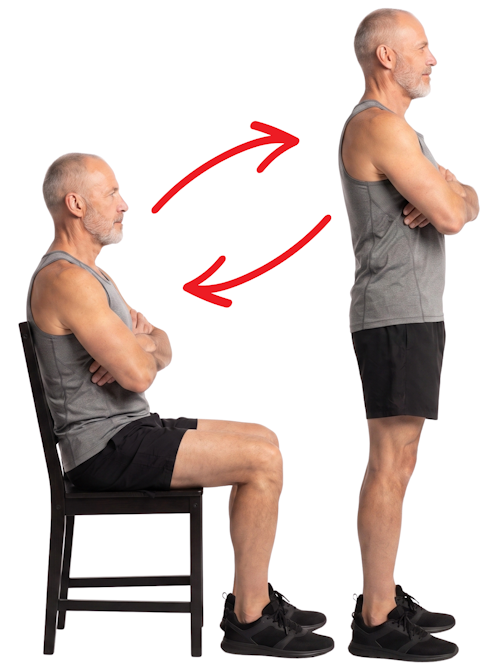
Strength fades faster than muscle does. At 75, men lose 3 to 4% of their strength every year. Women lose 2.5 to 3%. Speed goes faster still. So measure it. Sit in a firm chair, arms crossed over your chest, and count how many times you can stand fully up and sit fully down in 30 seconds. A good target is 14 or more for men, 12 or more for women. Those are the numbers for a healthy 60 to 64-year-old, and they’re worth aiming for at any age. If you’re well below that, mention it to your doctor. Deep dive here: https://pubmed.ncbi.nlm.nih.gov/35228201/
Write your number down today. Then do these four exercises twice a week (takes less than twenty minutes). Then retest yourself in eight weeks. I think you’ll be pleasantly surprised by how much you’ve improved. |
Build Strong Legs: Watch These Next
|